
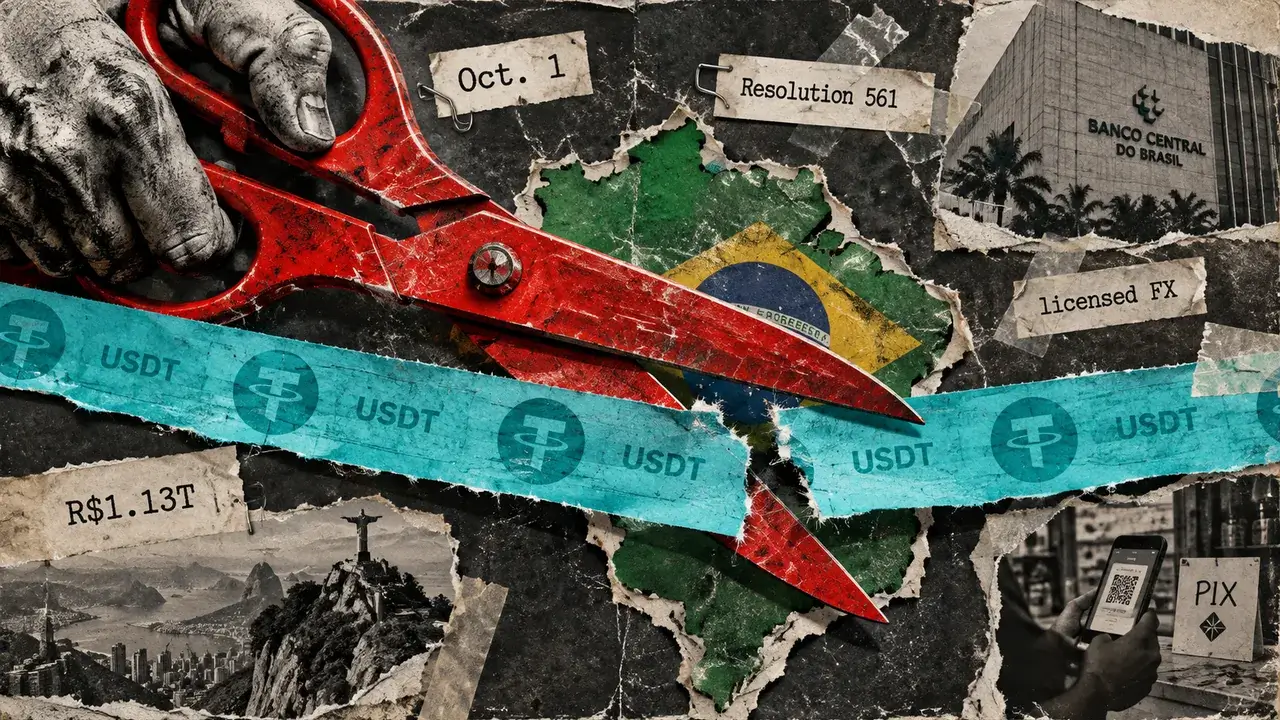
Brazil’s central bank will bar virtual assets, including stablecoins, from settling one specific type of international payment flow starting Oct. 1.
Resolution 561 targets the settlement leg between regulated foreign-exchange providers and their overseas counterparties, requiring that leg to run through a licensed FX transaction or a qualifying non-resident real account.
Individual international transfers using virtual assets remain permitted under Brazil’s existing framework.
| Activity | Status after Oct. 1 | Why it matters |
|---|---|---|
| eFX providers netting and consolidating multiple international payments | Still allowed | The core eFX aggregation model remains intact |
| Settlement between eFX provider and foreign counterparty using stablecoins or other virtual assets | Barred | This is the specific shortcut Resolution 561 removes |
| Settlement through licensed FX transaction | Allowed | Keeps the flow inside the formal FX system |
| Settlement through qualifying non-resident real account | Allowed | Provides a regulated alternative settlement path |
| Individual international transfers using virtual assets | Still allowed | Shows the rule is not a general stablecoin ban |
A gap in stablecoins that the central bank decided to close
Oscar Guillermo Farah Osorio, founding partner at Zanella & Farah, described the move to CryptoSlate as resolving genuine ambiguity.
Brazil’s 2022 virtual assets law had already given the central bank authority to decide which crypto operations count as foreign-exchange activity, but specific rules never followed, leaving a gap some market participants used to their advantage.
The eFX model these providers operate under lets them bundle many individual payments together, netting balances across an entire day before settling once with their foreign counterparty.
That structure suits high-volume, low-value flows like streaming subscriptions, online gaming payments and e-commerce transactions especially well. Farah said the new resolution directly closes that ambiguity, giving the central bank clearer visibility into flows it previously could not fully see within the formal exchange system.
What stays possible to do with stablecoins
Providers can still net and consolidate balances before settling with foreign counterparties. Farah framed the practical effect as removing one settlement method from an otherwise intact structure, since providers retain both the consolidated eFX model through permitted channels and the option of individual virtual-asset transfers outside it.
What disappears is the specific combination of stablecoin settlement with bulk aggregation, and Farah argued that combination is where much of the cost advantage lived.
Losing it could mean absorbing Brazil’s financial transaction tax on conventional FX conversions. It could also mean paying correspondent-bank and SWIFT-network fees that stablecoin settlement previously avoided, real costs Farah expects will eventually land on Brazilian consumers and businesses.
Brazil’s tax authority recorded R$1.13 trillion in declared stablecoin transactions between August 2019 and December 2025, roughly 72% of all declared crypto activity in that window. Stablecoins accounted for close to 80% of declared volume in 2025 alone, and USDT made up nearly 89% of that stablecoin total.
| Metric | Figure | What it shows |
|---|---|---|
| Declared stablecoin transactions, Aug. 2019–Dec. 2025 | R$1.13 trillion | Stablecoins are a major part of reported Brazilian crypto activity |
| Stablecoin share of declared crypto activity in that window | ~72% | Stablecoins dominated declared transaction volume |
| Stablecoin share of declared crypto volume in 2025 | Close to 80% | Their role has remained large into the current regulatory period |
| USDT share of declared stablecoin volume | Nearly 89% | Brazil’s stablecoin market is heavily dollar-stablecoin driven |
| Publicly isolated eFX settlement volume affected by Resolution 561 | Not available | The adoption data does not measure the restricted channel directly |
The cost problem
A July Bank of Italy study tested 200-dollar USDC transfers across ten international corridors, including Brazil, and found total costs ranging from 0.3% to nearly 9%, with no consistent advantage over conventional payment channels.
The study never examined Resolution 561 specifically, and it found something else worth noting. The blockchain transfer itself accounted for only a marginal share of total cost, while currency conversion and local payment infrastructure drove most of the expense.
Settlement finished in under 20 minutes where instant payment systems existed and stretched to one or two business days everywhere else. The Financial Stability Board reached a similar conclusion in July.
Stablecoins’ near-term value may sit inside hybrid arrangements built around existing bank money and settlement systems, short of functioning as standalone global payment rails.
Cregis CEO Shawn Yan said the more consequential move is happening inside brokers’ own infrastructure. He noted brokers are using stablecoins for treasury management, liquidity movement between entities and internal settlement, all invisible to the end client.
As volumes grow, Yan said the question shifts from whether to use stablecoins to how much of that infrastructure a broker wants to control directly, including fund location, transaction speed, and internal approval processes.
He said that the core business is still FX, and what’s changing is the infrastructure underneath it. Yan expects the practical response to regulatory restrictions to stay architectural, well short of avoidant.
Brokers can keep wallets and treasury controls in-house wherever permitted, while routing specific legs through licensed intermediaries wherever a jurisdiction requires it.
Yan said:
“You can’t build the model around one assumption about how stablecoins will be treated everywhere.”
| Function | Likely handled in-house | Likely handled through licensed partners |
|---|---|---|
| Wallet management | Yes, where permitted | Sometimes, if custody rules require it |
| Treasury visibility | Yes | No, but partner data must feed internal systems |
| Internal approvals and access controls | Yes | Usually integrated into partner workflows |
| Liquidity movement between entities | Often | When local rules require a regulated intermediary |
| Settlement into local currency or regulated FX channels | Limited | Yes, especially in restricted jurisdictions |
| Compliance reporting | Shared responsibility | Often depends on local licensing rules |
The outcomes for the hybrid infrastructure
Farah also raised a question the resolution leaves open. Brazil’s own virtual-assets law lists free enterprise, competition and operational efficiency among its stated goals.
He asked why individual international stablecoin transfers stay permitted while the aggregated eFX version does not, especially given that regulated providers could plausibly supply the same underlying transaction data the central bank wants either way.
He reads the rule mainly as an attempt to keep flows inside channels the central bank can already see and control, well short of any genuine conceptual break in how regulators classify stablecoins themselves.
The bull case has Brazil’s explicit boundary reducing legal uncertainty, with larger firms obtaining the right permissions, partnering with licensed institutions, and building standardized compliance workflows around the restriction.
Under that path, stablecoins keep working for treasury management and cross-border liquidity everywhere outside the specific eFX leg now closed. Firms are starting to market them as operational infrastructure, offering faster reconciliation and programmable controls.
The bear case is that the required settlement path adds enough FX, banking, and correspondent costs that stablecoins lose much of their advantage for Brazil-linked flows specifically. Smaller payment firms may struggle to justify building separate architecture for one market.
In that scenario, the central tension becomes whether any meaningful efficiency survives once the full regulated payment chain gets priced into the transaction.
Brazil’s October rule is a reminder that settling the value that stablecoins move across borders still depends entirely on which border it happens to cross.