
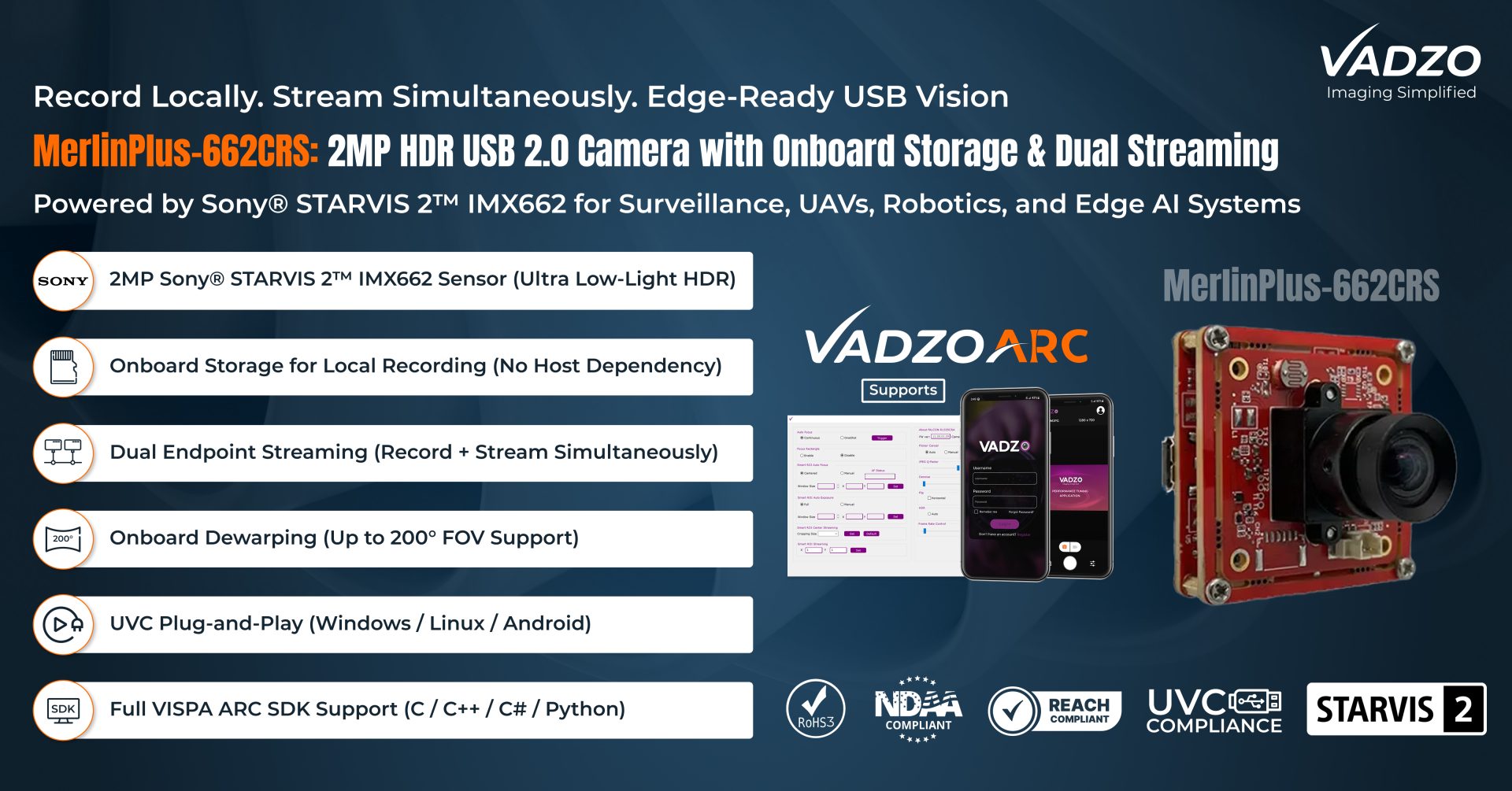
2MP HDR USB 2.0 UVC Camera | Sony STARVIS 2 IMX662 | Onboard Storage with uSD Card Slot | Dual Endpoint Streaming | H.264 + H.264 or H.264 + MJPEG | Onboard Dewarping up to 200° FOV | UVC Plug-and-Play | VISPA ARC SDK
Vadzo Imaging, a global leader in embedded vision, today announces the launch of the MerlinPlus-662CRS, a 2MP HDR USB 2.0 UVC camera built on the Sony® STARVIS 2™ IMX662 sensor, integrating onboard storage and dual endpoint streaming within a compact UVC-compliant module. The MerlinPlus-662CRS introduces a fundamental shift in USB camera architecture: it removes dependency on host-based storage by enabling simultaneous local recording and real-time streaming directly from the camera. By combining onboard storage, dual streaming, and onboard dewarping, Vadzo delivers an edge-capable imaging system in a plug-and-play USB form factor. For embedded vision developers, surveillance system designers, and OEMs building edge AI systems, this eliminates a critical system constraint: continuous reliance on host connectivity for data capture, storage, and reliability.
The MerlinPlus-662CRS Sony Starvis 2 IM662 HDR Storage USB 2.0 UVC camera is built on the Sony STARVIS 2 IMX662 CMOS image sensor, a 1/2.8″ format device with 2.9 µm × 2.9 µm pixel pitch and a maximum resolution of 2MP (1920 × 1080). The STARVIS 2 generation delivers measurably improved low-light sensitivity and HDR performance over its predecessor, with larger pixel architecture that captures more photons per pixel and reduces noise at lower illumination levels. The sensor supports rolling shutter readout with HDR processing, producing stable colour reproduction and preserved highlight-shadow detail in high-contrast scenes. On the camera side, the MerlinPlus-662CRS uses a USB 2.0 Micro-B interface with full UVC compliance, operates across −30°C to 70°C, and accepts standard M12 (S-Mount) optics in 105°DFOV and 200° DFOV configurations, with the 200° variant supported by onboard dewarping that delivers geometrically corrected output without host-side processing.
Onboard Storage with Dual Endpoint Streaming: Standard USB camera architectures write all video data through the host – making capture reliability directly dependent on host connectivity, USB bandwidth stability, and host-side storage availability. In distributed deployments such as UAVs, mobile robots, and remote surveillance nodes, this creates a hard dependency that increases system complexity and introduces single points of failure. The MerlinPlus-662CRS On Board Storage USB 2.0 UVC Camera addresses this with an integrated uSD card slot, allowing video to be recorded directly to removable storage on the camera itself, independent of host connectivity. The camera supports continuous local recording to microSD, enabling uninterrupted capture even when the USB link is intermittent, bandwidth-constrained, or temporarily unavailable. Recorded footage can be retrieved by physically removing the uSD card or accessed via the host file system when the USB connection is active.
Dual Endpoint Streaming – The MerlinPlus-662CRS Dual Endpoint Streaming USB 2.0 UVC camera exposes two independent USB video endpoints simultaneously, enabling the host to receive two concurrent video streams from a single camera without additional hardware or splitting infrastructure. Supported stream configurations include dual H.264 streams at independent resolutions and bitrates, useful where one stream feeds a local analytics pipeline and a second feeds a remote monitoring or recording system. The camera also supports a combined H.264 + MJPEG configuration, where the H.264 stream provides bandwidth-efficient compressed video for transmission or storage while the MJPEG stream delivers high-quality individual frames for applications that require low-latency frame access, such as machine vision analytics or real-time inference pipelines. Both endpoints operate concurrently over the single USB 2.0 connection, with each stream independently configurable for resolution, frame rate, and compression parameters via the VISPA ARC SDK.
Ultra Low-Light HDR Imaging with STARVIS 2: Imaging in low-light and high-contrast environments challenges conventional USB cameras, often producing noisy or underexposed frames. Built on the Sony STARVIS 2 IMX662 sensor with 2.9 µm pixels, the MerlinPlus-662CRS Sony Starvis 2 IMX662 HDR camera delivers high-sensitivity HDR imaging that preserves detail across extreme contrast ranges, ensuring geometrically accurate and usable frames in near-dark conditions. Applications including night-time surveillance, ANPR systems, and dynamic indoor/outdoor transitions rely on the MerlinPlus-662CRS to maintain consistent, actionable image quality without complex lighting setups, enabling reliable operation in edge deployments where conventional cameras fail.
Onboard Dewarping for Wide-Angle and 360° Vision: Wide-angle and fisheye lenses typically require host-based distortion correction, which adds latency, increases CPU load, and complicates real-time deployment. The MerlinPlus-662CRS performs dewarping internally, supporting lenses up to 200° FOV while delivering real-time, geometrically accurate output. This capability ensures panoramic surveillance, kiosks, and retail analytics systems maintain high-quality, corrected imaging without burdening the host processor, enabling reliable edge deployment even on constrained hardware.
Compact, Low-Power USB 2.0 Integration: Embedded and edge deployments often require driverless, low-power, compact imaging solutions to fit within constrained systems and portable platforms. The MerlinPlus-662CRS operates over USB 2.0 with full UVC compliance, providing plug-and-play operation across Linux, Windows, and Android without host-side drivers. Its dual-board 38 mm × 38 mm design and 11 g weight ensure integration into space- and power-constrained systems, enabling reliable edge vision performance in battery-powered and portable applications.
Plug-and-Play Integration with VISPA ARC SDK
Edge and embedded developers need full control over camera operation without adding host-side complexity. The MerlinPlus-662CRS delivers this through full UVC compliance for driverless deployment across Linux, Windows, and Android platforms.
For advanced integration, VISPA ARC SDK exposes streaming configuration, exposure, gain, ROI, and firmware management, with APIs in C, C++, C#, and Python. This enables seamless, production-grade integration across diverse embedded and edge systems, reducing development time and ensuring consistent, reliable operation in complex deployments.
Smart Surveillance and Edge Recording: Conventional USB cameras lose footage when host connectivity drops. The MerlinPlus-662CRS records continuously to onboard uSD storage while simultaneously streaming to the host – ensuring complete capture even under intermittent connectivity. Dual H.264 endpoints allow one stream to feed local edge analytics and a second to transmit to a remote VMS, without additional splitter hardware.
ANPR and Traffic Monitoring: Low-light and high-contrast road conditions challenge conventional USB cameras. The STARVIS 2 IMX662’s large pixel pitch and HDR processing maintain usable frame quality for licence plate recognition across day-to-night transitions, while onboard recording ensures no frames are lost during host processing delays or connectivity interruptions.
Retail Analytics and Kiosks: Wide-angle and fisheye lenses typically require host-side distortion correction. Onboard dewarping with lenses up to 200° DFOV delivers geometrically corrected panoramic output directly, reducing CPU load on embedded kiosk hardware. The H.264 + MJPEG dual stream configuration simultaneously feeds a compressed recording stream and a high-quality frame stream for real-time shopper analytics.
UAVs and Mobile Platforms: Intermittent RF connectivity during flight or mobile operation makes host-dependent recording unreliable. Local recording to uSD ensures complete mission footage capture independent of ground station link quality, while the live H.264 stream continues to transmit to the host when connectivity is available.
Robotics and AGVs: Navigation and diagnostic systems require uninterrupted vision data. The dual endpoint architecture allows one H.264 stream to feed the onboard navigation pipeline and a second to record diagnostic footage to uSD, providing an independent log for post-mission analysis without adding host processing overhead.
Medical and Embedded Devices: Portable diagnostic systems require compact, self-contained imaging with local data capture. The uSD slot enables patient data to be recorded locally on the device without external storage infrastructure, while the live USB stream feeds the host application, supporting both real-time display and local archival in a single module.
The MerlinPlus-662CRS IMX662 HDR USB 2.0 Camera with onboard storage is now available for evaluation and production orders. Evaluation kits include the camera, M12 lens, USB cable, and VISPA ARC SDK documentation, with no minimum order requirement. Contact [email protected] or +1 817-678-2139 to request an evaluation kit or discuss OEM customization.
Vadzo Imaging is a global leader in embedded vision solutions, providing high-performance cameras and imaging platforms for applications in robotics, industrial automation, UAVs, edge AI, and medical devices. Its products are optimized for seamless integration with platforms such as NVIDIA Jetson, Raspberry Pi, Qualcomm RB series, and NXP i.MX. Vadzo accelerates customer deployments through hardware customization, firmware development, and the VISPA ARC SDK, enabling faster, reliable implementation of vision-based systems.